
Have you ever looked back at your life and thought: “Wow, I was living a completely different version of myself back then”?
It can feel almost like looking at a stranger in an old photo. The way you dressed, the goals you had, even the way you carried yourself — it was you, but not the you you are today.
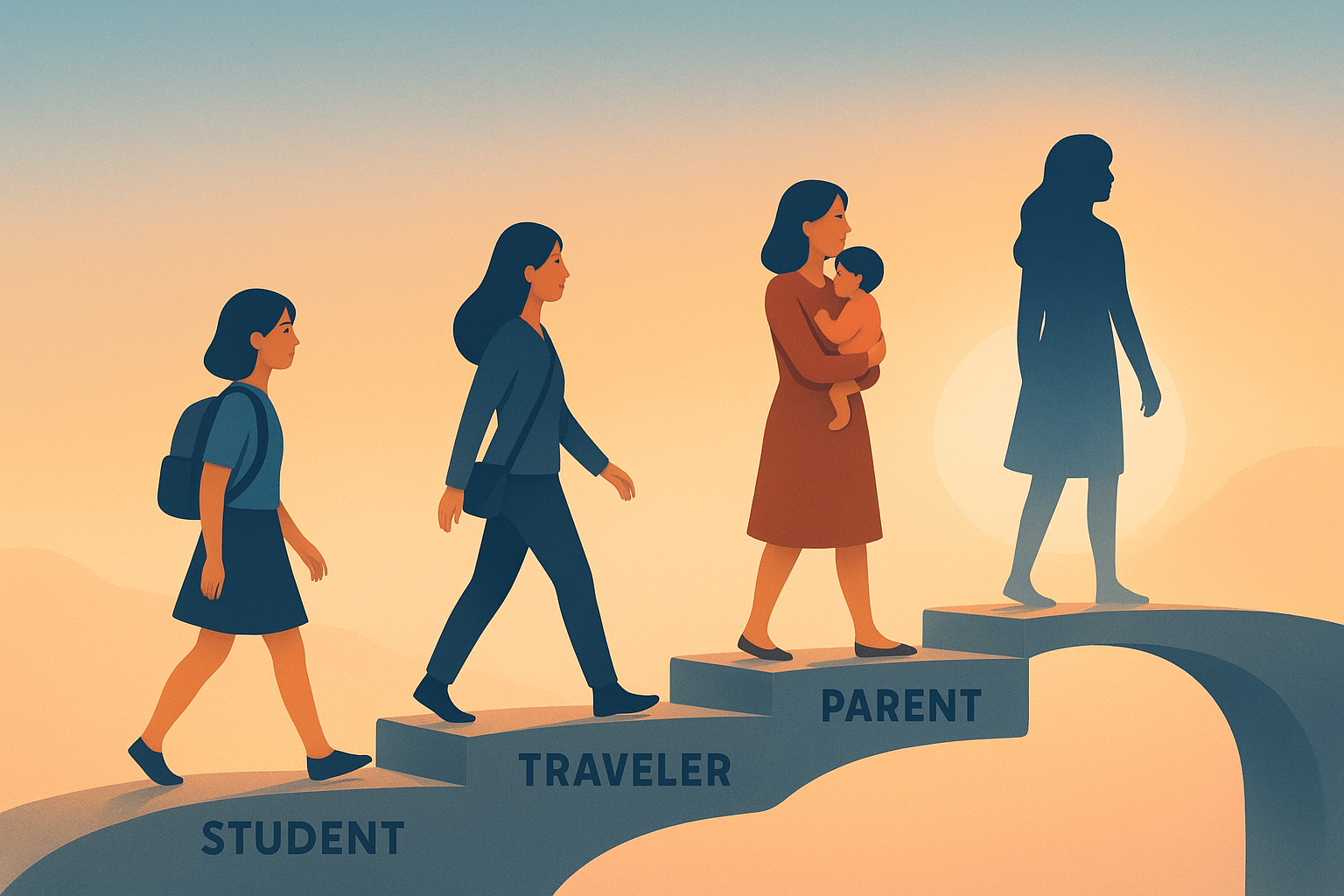
Have you ever wondered how many versions of “you” there have been? The student. The worker. The traveler. The parent. The achiever. The dreamer. Each of these roles, whether embraced with intention or simply fallen into, makes up what psychologists call identity projects—the ongoing stories we tell ourselves about who we are and who we might become.
When Life Chooses Who We Become
Most of us don’t consciously choose these shifts. We adapt, we fit in, we follow opportunities or expectations. Without realizing it, we move from one identity to another like travelers boarding trains without checking the destination. This is the unconscious drift of identity—life lived on autopilot, where friends, habits, culture, and circumstances quietly guide our sense of self.
There’s nothing wrong with drifting. It’s human. But it can leave us feeling disconnected, restless, or unsure of who we really are.
A new job, a sudden loss, a relationship, or even a random conversation can send us in a new direction. And often, we only realize the change years later.
Consider a teenage punk-rock fan with an Iroquois haircut. At the time, it might have felt rebellious or just fun. But beneath the music and style, it was an experiment in belonging, in finding a voice, in testing boundaries. Looking back, you might smile at the hairstyle — but the courage to stand out or question norms is something that can still serve you today.
Think about these moments:
• The first big job offer. You didn’t consciously decide to become “the career-focused one,” but suddenly your calendar, your wardrobe, and your sense of worth started revolving around work.
• A breakup or divorce. Without planning it, you may have slipped into the role of “the independent one,” building a new version of yourself around strength and survival.
• Becoming a parent. One day you were free to travel light, the next you were “the caregiver,” your identity woven around bedtime routines and responsibility.
• A health scare. In a moment, you shifted from living as if you were invincible to living with greater caution — or greater gratitude.
These identity shifts often happen while we’re on autopilot. Life nudges us, and we quietly reshape ourselves to adapt.
Choosing Who We Become
The good news is this: identities are not cages, they’re projects. And projects can be shaped, adjusted, or reimagined at any stage of life.
You can start by asking simple, grounding questions:
• Who am I living as right now?
• What part of this identity feels chosen — and what part feels inherited or accidental?
• If I could shift even one thing, what would bring me closer to the person I want to be?
Even pausing to ask these questions is a way of stepping out of autopilot. Awareness turns drifting into navigating.
Reflection is valuable, but what really brings change is practice — small actions that gently guide us toward the identity we want to live.
Everyday Shifts in Action
Sometimes, the desire for a new identity starts with a restless feeling: “I don’t want to live like this anymore.” It doesn’t always take a dramatic event to spark change — even small shifts in habits or surroundings can start reshaping who we are becoming.
Take, for example, a man who still feels more like a boy than a man. Hours lost in front of a PlayStation or computer screen may have kept him from stepping into a stronger, more grounded identity. His shift might begin with replacing some of that gaming time with something that feeds the man he wants to become — weight training, martial arts, volunteering, or even learning a skill that demands discipline. These aren’t just hobbies; they help his brain release more testosterone and wire him into a more mature sense of self.
For women, the same principle applies. If you feel caught in a loop of hyper-independence — strong, capable, but also restless or disconnected from the softness you long for — your shift might begin with choosing new environments and company. Instead of always surrounding yourself with women who complain about life, carry disappointment, or have hardened themselves into a masculine energy they never really wanted, seek out more feminine, radiant role models. Spend time with women who laugh easily, who nurture, who live with openness. Our identities are shaped not only by what we do, but also by who we spend time with.
Neither example is about “fixing” who we are. They’re about creating the right conditions — biologically and psychologically — for the identity we long for to naturally emerge.
And in today’s digital world, one of the most practical steps is to consciously shape your online environment. Consider who you follow and who you unfollow. Your social media feeds are not neutral — they are daily training grounds for your thoughts, moods, and sense of self. Start following people, communities, or voices who reflect the identity you want to grow into. Little by little, even the algorithm can become your ally in shifting who you are becoming.
Despite the fact that you might already be conditioned to a certain type of content and thought patterns, pause and ask yourself:
Is this content fueling my desired identity, or the one I’m ready to leave behind?
And just as importantly: What kind of content would support the identity I want to grow into — and who is producing it, so I can start following them from now on?
It’s not only online influencers who shape us — public figures can spark identity shifts too. In Finland, for example, when former Prime Minister Sanna Marin appeared in a leather jacket, suddenly many Somali sisters started wearing one. A simple style choice became a ripple of identity play, showing how quickly our environment can influence who we try on being.
Every Identity Is a Bridge
Instead of seeing each identity as a rigid box, imagine them as bridges. Each stage of your life connects to the next, carrying wisdom and experience. The “worker” can learn from the “student.” The “parent” can rediscover the “dreamer.” Nothing is wasted. Every past identity can serve your present and future.
Practical Ways to Shape Your Next Identity
Here are a few small practices that can help you move from unconscious drifting to conscious shaping:
• Journal about your past selves. Write down the identities you’ve lived so far (student, caregiver, achiever, seeker, etc.) and note what each gave you — and what you might want to carry forward.
• Name your current identity. Give it a title. Maybe you’re “the explorer,” “the builder,” or “the healer.” Naming it makes it visible.
• Play with possibility. Ask yourself: What identity is quietly waiting in the wings? Maybe you feel a pull toward “the artist” or “the activist.” Allow yourself to imagine it.
• Take a micro-step. If you sense a new identity calling, don’t wait for a major life event. Start small — pick up a paintbrush, join a group, take a walk in a place that reflects your values. Small steps are identity seeds.
Your Story Isn’t Finished
If you’ve spent years on autopilot, you haven’t lost time — you’ve gathered raw material. Every past version of you has left tools and lessons behind. You can choose which ones to carry forward as you shape your next chapter.
Know this: it’s never too late to step into the driver’s seat. Identities are not permanent tattoos; they’re more like evolving artworks. With reflection, curiosity, and courage, you can begin shaping a new version of yourself—one that feels aligned with your values and desires.
Life will always bring shifts, some chosen and some unexpected. But within those shifts lies a profound opportunity: to wake up, to choose, and to author your own story.
Identity is not about fixing who you are. It’s about becoming — and that is always available, no matter where you start.
The next chapter of your story is unwritten. You are the author — and you can begin writing today.
You don’t need to reinvent yourself overnight. All you need is to notice who you are today — and dare to take one small step toward who you might become.
Your next identity project doesn’t need to be radical either. It only needs to be intentional. Start small. Start today.
If you liked this article or it managed to rouse emotions of any kind, stay tuned for our upcoming insightful articles. Don’t miss out on inspiring stories, expert advice, and fresh perspectives on creating a fulfilling and balanced life. Subscribe now to be among the first to receive these enriching articles straight to your inbox! Make today your best one yet.
Image: Pixabay.com
Leave a Reply